Choose a shared base and serve some components separately, including familiar foods your household already eats. Keep the plan manageable and use substitutions that fit your family’s dietary needs.
Plan a base, a few components and a familiar option
Think wraps, rice bowls, pasta or baked potatoes. You can prepare a common base and offer a few combinations without cooking a whole new meal for each person. This is a planning technique, not a promise to change a child’s eating preferences.
Choose familiar items as part of the meal from the start. That can make the plan easier to execute than inventing a rescue dinner after everything else is on the table.
Three dinners with room to choose
These are examples to adapt, not prescribed menus.
| Base | Shared components | Simple serving choice |
|---|---|---|
| Wraps | Beans or chicken, chopped vegetables, cheese or another topping | Put components on the table separately |
| Pasta | Sauce, vegetables and preferred protein | Keep some pasta plain before combining |
| Baked potatoes | Beans, tuna or another filling; vegetables | Let each person choose suitable toppings |
Keep swaps on the shopping list
Write down the substitution you plan to use so the shopper does not have to solve it in the aisle. Check labels and preparation needs for allergies or other dietary requirements. A familiar-looking food is not automatically an appropriate replacement for everyone.
Tell Kaia what your family actually eats.
Family preferences belong in the plan from the start. Give Kaia your familiar meals, dietary needs and busy nights, then ask for dinner ideas with components people can share. You still choose what works at your table.
Repeat the structure before chasing new recipes
If a wrap night works, keep the structure and change one component when you want variety. Repeating an easy format can reduce your planning work while leaving choices at the table.
Keep a note of practical discoveries: separate the sauce, cut vegetables differently, make extra plain rice. Describe what happened without turning the meal record into a scorecard for the child.
Match the meal to the evening
A night with little time is probably not the moment for the most unfamiliar dinner. Keep those evenings simple and put experiments where the household has more room. Plan a fallback you can prepare without restarting the whole meal.
Know when planning advice is not enough
If eating causes ongoing distress, affects growth or raises medical concerns, speak with a qualified clinician who knows your child. A planner can help with the logistics; it is not a treatment. For everyday planning, begin with a smaller menu and a routine your household can sustain.
See a worked family example
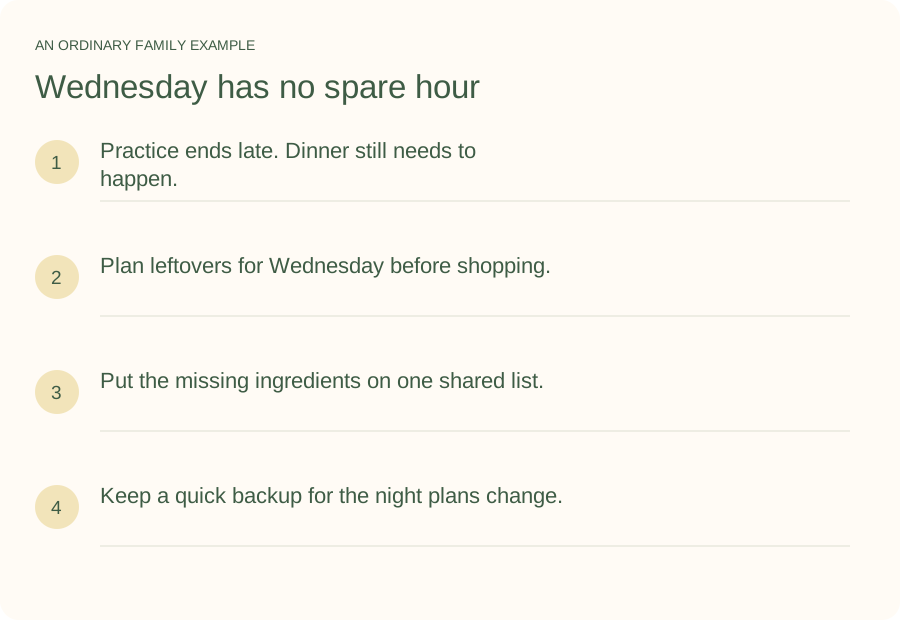
Illustrative household example; adapt the names and details to your week.
A few common questions
Do I need to cook a different dinner for everyone?
Not always. A shared base with separate components can accommodate preferences while keeping preparation manageable. Adapt to your household’s needs rather than making identical plates the goal.
How do I plan variety without starting from scratch?
Keep a few familiar meal structures and change one ingredient or topping. Save notes about useful serving adjustments and reuse them in the next plan.