Start with your available grocery budget and pantry, choose flexible meals with overlapping ingredients, and compare the complete shopping basket. Leave room for breakfast, lunches and household essentials.
Give the budget a real boundary
Decide what this shop needs to cover and for how many days. Dinner-only planning can miss the breakfast cereal, school snacks and washing-up liquid that arrive in the same basket. Separate those costs before choosing the evening meals.
Build a week around a small ingredient set
Use this example as a structure. Prices and suitable ingredients vary by location and household.
| Dinner | Useful overlap |
|---|---|
| Bean chili with rice | Beans, tomatoes and rice |
| Filled baked potatoes | Use a suitable leftover portion or a fresh filling |
| Vegetable pasta | Use remaining vegetables and tomatoes |
| Egg or bean wraps | Use wraps and vegetables in lunches too |
| Rice bowls | Use the planned protein and vegetables |
| Soup and toast | Use suitable produce that needs cooking |
| Flexible dinner | Choose after checking what remains |
Price the basket before calling it cheap
Compare pack sizes and unit prices where available. A larger pack only helps when you can use or store the extra. Check whether a suggested saving creates waste or another purchase elsewhere in the plan.
Write estimated and actual costs in the budget worksheet. Use your own shop’s prices; this guide does not promise a universal cost per family or per meal.
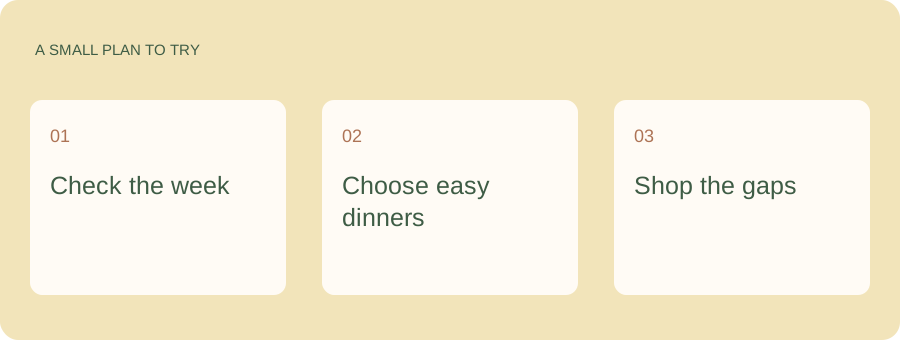
Give the budget and the cupboard a place in the plan.
Tell Kaia what you want to spend and what is already at home. Ask for meals that reuse ingredients, then use the worksheet to check local prices and the final shopping total.
Give leftovers an actual destination
Name the next meal that will use them and plan safe storage. “We will eat them sometime” is an easy route to a crowded fridge. If a leftover will not fit into the next meal safely, freeze it where appropriate or make a smaller batch.
Keep an inexpensive backup
Choose a dinner made from ingredients you normally keep. It should be something the household will eat and that the available adult can prepare. A backup reduces the chance that one changed evening turns into an unplanned expensive shop.
Review waste, not just the receipt
At the end of the week, note what was left unused and what you had to buy unexpectedly. Those two observations make the next budget more useful. You do not need to record every mouthful to improve the plan.
Keep the successful meals and swap the ones that did not fit. A budget plan gets easier when you reuse what you learned, rather than searching for seven completely new “cheap dinners” every Sunday.
See a worked family example
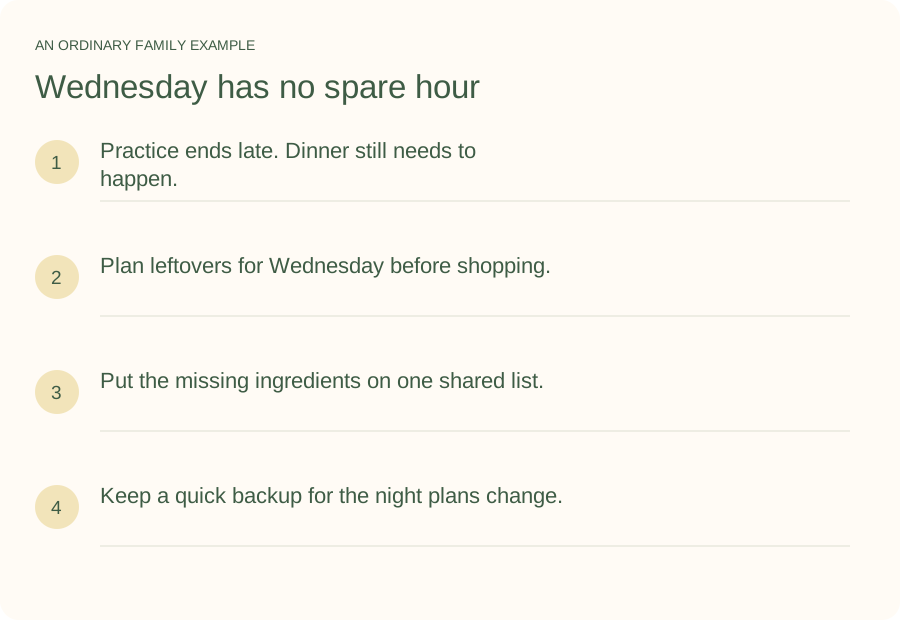
Illustrative household example; adapt the names and details to your week.
A few common questions
What is a realistic weekly food budget?
It depends on household size, location, dietary needs and what the shop covers. Start with your recent spending and build an itemized basket. Use your own prices rather than a universal online target.
Does batch cooking always save money?
Only when the household uses the food and you can store it safely. Plan the destination for each extra portion before buying a larger quantity.