Look at the coming week, settle the plans that affect other people, assign the unresolved jobs and stop. Keep the agenda short and record decisions rather than every part of the conversation.
Pick a repeatable moment
Choose a time when the people involved are usually available and not already halfway out the door. Keep the first attempt to ten or fifteen minutes. Children can join the parts that affect them without sitting through every adult scheduling detail.
Use this short agenda
Give the meeting a finish line.
| Time | Question | Write down |
|---|---|---|
| 2 minutes | What is different this week? | Changes to school, work or activities |
| 3 minutes | Who is taking whom, and when? | Transport and handoff owners |
| 3 minutes | Which dinners need a plan? | Busy nights and meal owners |
| 3 minutes | What needs doing before a date? | Task, owner and deadline |
| 2 minutes | What needs more discussion? | A separate time or next step |
Bring the information, not a polished presentation
Each person checks their own calendar or responsibilities before the conversation. You do not need one adult to prepare a household slide deck. Put the relevant dates where everyone can see them.
If a school message is unclear, record the question and who will resolve it. Do not spend the entire meeting searching three inboxes while everybody else waits.
Give the family meeting a head start.
Tell Kaia what is happening this week and ask for help sorting dates, meals and open questions. Bring that starting point to the meeting so you can spend your time making decisions together.
Write decisions in a form someone can use
“Party sorted” is less useful than “Sam replies by Wednesday; Alex buys the present by Friday.” Record the smallest set of details needed to act: owner, due date and relevant link or location. Keep discussion notes out of the shared action list unless they change what happens.
Give disagreements another place
If a larger issue needs time, name it and agree when to discuss it. The weekly check-in should not turn into a review of every frustration since last month. You can still settle the immediate logistics while leaving room for a proper conversation later.
End with the next visible plan
Read back the important handoffs and make sure everybody can find the result. A short message to the shared family conversation can be enough. The editable agenda includes a decision list you can copy or print.
At the next meeting, begin with what changed. Do not spend the whole time auditing last week’s boxes. The purpose is to make the coming week easier.
What a finished agenda can look like
For an illustrative busy week: Tuesday appointment means Alex collects early; Wednesday dinner uses Monday’s leftovers; Sam replies to the trip notice by Thursday. The unresolved question is Saturday transport, which Alex confirms tomorrow.
That is enough to end the meeting. Copy the decisions into your shared plan and let each owner handle their next step. If the week is already settled, use the time for something else.
See a worked family example
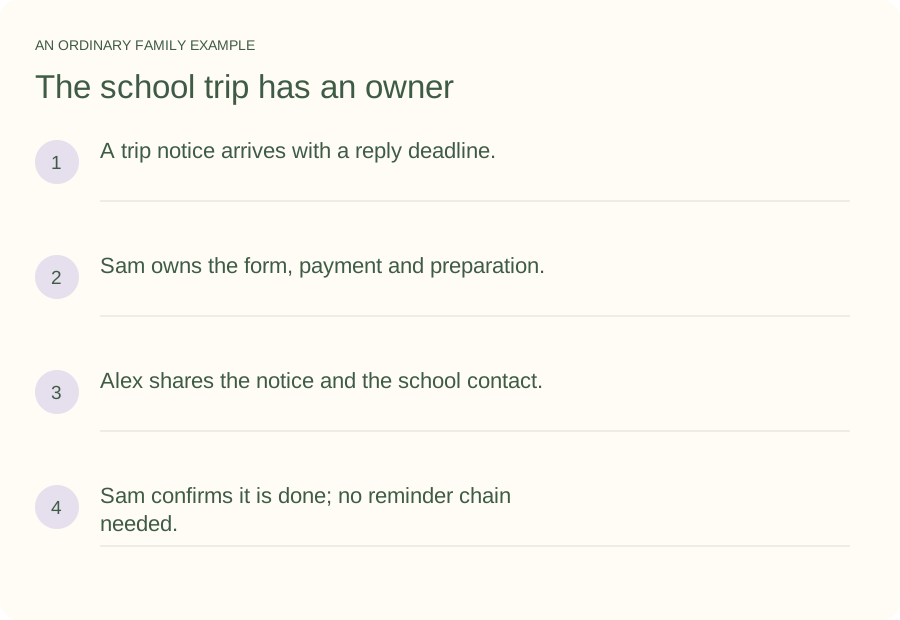
Illustrative household example; adapt the names and details to your week.
A few common questions
Do children need to attend?
They can join the relevant parts, such as activities, routines or a family choice. Keep adult coordination proportionate and adapt the format to their age and interest.
What if we cannot meet at the same time?
Use the same short agenda in a shared message or document. Each adult adds their updates by an agreed time, then resolve only the remaining questions together.