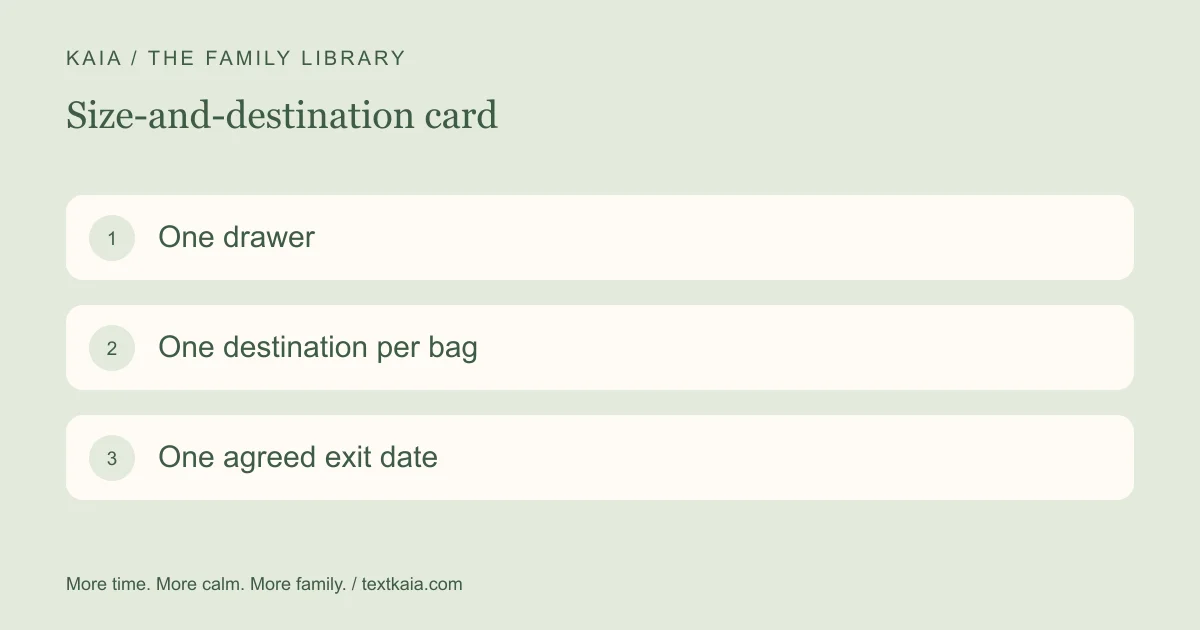
Sort outgrown children’s clothes by their next destination: keep for a named child, pass on, donate, or sell. Give each bag an owner and an exit date. Store only the items you expect to use again, labeled by size and season, so you can find them when needed.
The plan at a glance
An outgrown-clothes system works when it ends with a handoff, not just a sorting session. Pick one small batch, decide its next destination and record only the information needed to finish. Give a cousin’s bag a name and collection date.
Clothes to save need a size, season and storage location. Selling needs an adult willing to photograph, list and post the items. If nobody wants that job, choose a different destination.
Revisit the process when a drawer stops closing rather than waiting for a perfect seasonal clear-out.
Start with the drawer that stopped working
Choose one child and one category, such as trousers. Pull out the pieces you already know don’t fit. Leave the rest of the wardrobe alone for now.
A clear floor and an easy-to-use drawer are useful results even if you haven’t sorted every baby sock.
Ask the child which familiar pieces they want to keep wearing before packing away borderline sizes. Try things on only when you need the answer; turning this into a fitting appointment for every T-shirt makes it harder to begin.
Give each destination a real destination
“Donate” needs a place that accepts those items and a way to get them there. Check the organization’s current donation guidance. “Give to someone” needs their agreement before you arrive with a bag.
For clothes you’re keeping, use a label like “size 6, cool-weather, hall cupboard.” A useful label helps another adult retrieve the clothes without asking you to translate your storage system.
Count the work of selling
The price you list isn’t money received. Someone still has to photograph, describe, answer messages and arrange delivery. Agree who wants that job and when they’ll do it.
Try a small limit: one bag for resale, reviewed on a chosen date. If it stays untouched, make another decision together. A modest donation that leaves the house can be more useful than a valuable pile nobody has time to manage.
Keep memories on purpose
Set aside a small space for pieces with a particular story. You don’t have to justify a sentimental favorite or keep every garment to prove that a stage mattered.
At the next size change, check saved clothes before buying more. Record what you actually have, not a detailed inventory of every item. “Winter coat, size 7, loft” may be all the information the next shopping trip needs.
A simple example
Illustrative household example. Replace it with your own details.
| Bag / size or season | Destination and owner | Exit date / storage location |
|---|---|---|
| Cousin bag | Alex asks whether it’s wanted | Collection agreed before Friday |
| Save for sibling | Sam labels size and season | Blue box, hall cupboard |
| Donation bag | Alex checks drop-off hours | Leaves with Saturday errands |
Related help: A household information system · Sharing household jobs.
Questions that come up
Should I keep clothes for a younger child?
Keep the sizes and seasons you reasonably expect to use, with a storage limit you can live with. Label the location so another adult can check before buying duplicates.
What if selling takes too much time?
Choose a smaller resale batch or another destination. Include the admin work in the decision rather than leaving it as an invisible extra task.
How often should we sort clothes?
Use a practical trigger: a size change, a crowded drawer or the start of a different season. A small recurring check can be easier than an annual overhaul.