Pick one busy part of the day and write its steps in order. Use short, visible actions, put the chart where it is needed, and leave time for help rather than scheduling every minute.
Start with one stretch of the day
Choose the morning exit or the evening reset. Do not try to map the whole day at once. Watch what actually happens for a day or two, then build the chart around the sequence your household can follow.
Use actions a person can see
A routine chart is a sequence, not a list of good intentions.
| Morning example | Evening example |
|---|---|
| Get dressed | Empty lunchbox |
| Eat breakfast | Check tomorrow’s bag |
| Brush teeth | Put required kit by the door |
| Pick up bag and bottle | Choose clothes |
| Check who is taking you | Finish the usual bedtime routine |
A school-morning routine with the adult jobs included
Illustrative starting chart for a school morning. Use the order that fits your household, including the help your child needs. Put the chart where the steps happen rather than expecting everyone to remember another list.
| Moment | Child’s step | Adult’s part | Make it easy to find |
|---|---|---|---|
| Before breakfast | Get dressed | Help with the parts they cannot manage yet | Clothes chosen the evening before |
| After breakfast | Brush teeth | Give the help or check that is needed | Toothbrush where it is used |
| Before shoes | Pick up bag and bottle | Check the permission slip or required kit | Bag, papers and bottle by the exit |
| At the door | Check who is taking you | Confirm the actual pickup and transport plan | A clear place for today’s plan |
Move one job out of the rush
If the bag is always the last-minute scramble, prepare it the evening before. If breakfast takes longer on a particular day, change the order. A chart is most useful when it helps you notice a bottleneck instead of simply naming it.
Keep supplies near their use: hooks for bags, a place for bottles, a tray for papers that need an adult. The chart and the physical space should tell the same story.
Make tomorrow morning easier to remember.
The routine chart gives everyone a sequence. Kaia gives the family a place to ask about it and get help with reminders, so you do not have to repeat the same instructions from the kitchen.
Include the adult handoff
A child can know every step and still need an adult for transport, a signature or a missing item. Put the adult’s job on the plan too. “Check reading folder with Dad” is clearer than expecting the child to remember an unnamed approval step.
Build a short version for difficult days
Some days need a smaller routine. Identify the essentials and leave the optional extras off the emergency version. A household should not feel it has failed because a difficult morning did not include every square.
Use the editable routine kit to keep the ordinary sequence and a short-day version on the same page. A visual cue or a small drawing can make it easier for early readers.
Review at the place where it happens
Walk through the routine with your child in the actual space. If the chart is in the kitchen but every step happens upstairs, move it. If there are too many words, simplify them. Small practical changes can matter more than a fresh design.
Adjust the routine where it gets stuck
If the same step causes a rush every morning, change the setup before adding more reminders. Move the bag nearer the door, put the kit check the night before, or allow more time for the step your child still needs help with.
Choose one change for a week. A useful routine grows from what your household can repeat. It does not need to look like another family’s morning.
See a worked family example
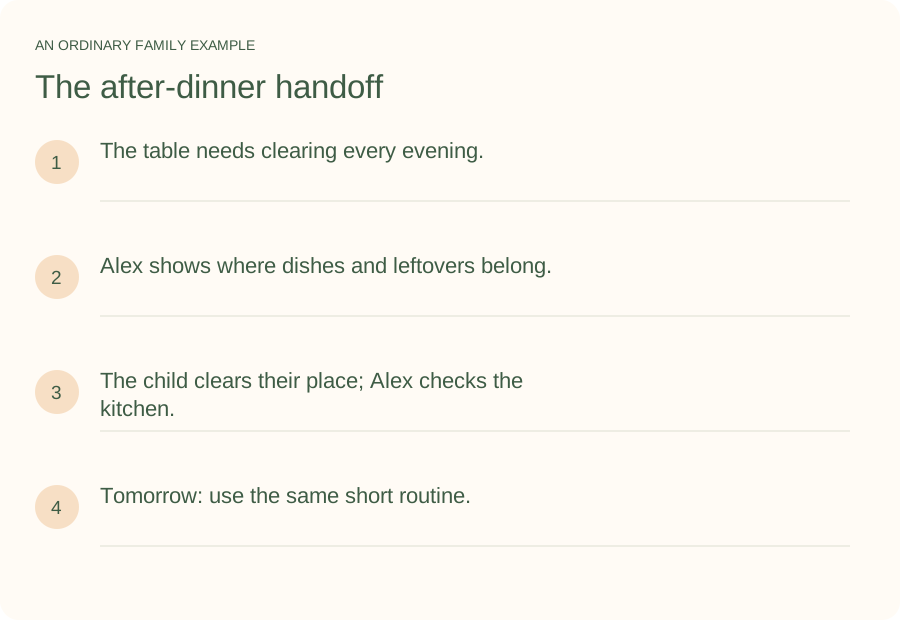
Illustrative household example; adapt the names and details to your week.
A few common questions
How long should a routine chart be?
Short enough to follow at a glance. Start with four or five meaningful steps for one part of the day, then adjust to the person using it.
Is a routine chart the same as a chore chart?
They overlap, but a routine chart shows order: what happens next. A chore chart assigns responsibilities over time. Use the format that matches the problem you are trying to solve.