To make everyday family decisions less tiring, choose a few repeatable defaults, give each one an owner, and keep the details somewhere everyone can find them. Start with low-stakes questions like dinner on activity nights. Leave room to change the plan when the default no longer works.
“What should we have for dinner?”
A reasonable question. Unless you’ve already answered what goes in the lunchbox, whether the swimming bag is dry, who’s collecting on Friday and where the permission slip went. At that point, choosing between pasta and rice can feel like being asked to chair another meeting.
A few repeat questions deserve a standing answer. Dinner after practice is a good place to start.
A practical way to reduce family decision fatigue
Start with one recurring choice that doesn’t need a fresh answer every day: dinner after practice, when bags get packed, or who replies to the club email. Agree on a usual answer and an adult who can change it. Keep both details in a shared place.
A dinner plan, for example, might say “pasta on swim nights; the person cooking chooses a backup if we’re out.” Try it for a week and notice whether the question still comes back to you. If it does, check what information or decision-making room the other adult is missing.
What does decision fatigue look like at home?
Decision fatigue describes feeling worn down by making decisions. It isn’t a medical diagnosis. Cleveland Clinic explains the distinction. Here, we’re talking about the ordinary household choices that keep landing in the same person’s lap.
Families can share the physical work and still leave one adult choosing how all of it happens. Someone else cooks, but you pick the meal. Someone else packs, but you write the list. Someone else collects, but you arrange the swap.
If that sounds familiar, our guide to the default-parent role looks at who becomes everyone’s first stop. This is the practical next step: taking a few recurring decisions off that person’s daily agenda.
Pick three decisions you’re tired of making
For one evening, notice the questions that repeat. Skip the giant household audit. You’re looking for small, predictable decisions with answers you’d be happy to reuse.
- What do we eat when practice finishes late?
- When does the school bag get checked?
- Who reads and replies to the weekly activity email?
Choose three that fit your home. If dinner already works, leave it alone. Choose something that would make tomorrow a little easier.
Give each decision a default and an owner
A default is the answer you use unless there’s a reason to change it. An owner is the adult who can make that change without sending every small choice back for approval.
| Recurring question | Our default | Who handles changes? |
|---|---|---|
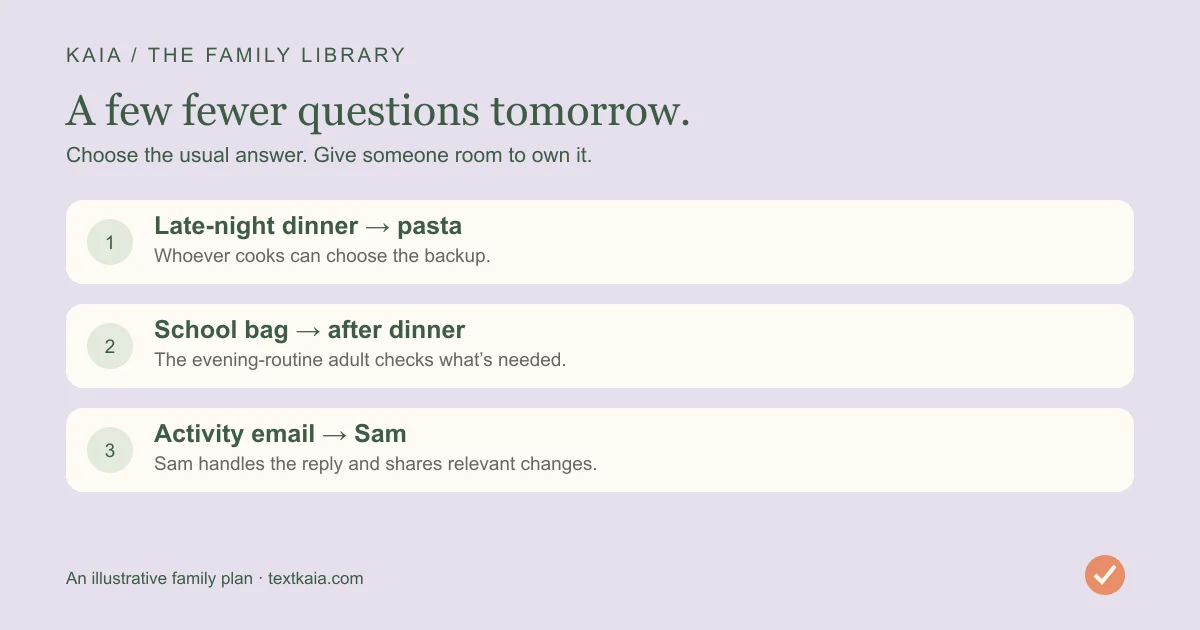
| What’s for dinner after practice? | Pasta and a freezer vegetable. | The adult cooking chooses a backup if we’re out. |
| When do we pack the bag? | After dinner, before the kitchen closes. | The adult doing the evening routine. |
| Who replies to the activity email? | Sam reads it and handles the reply. | Sam flags only changes that affect someone else. |
Illustrative household example. Use your own people, food and routines.
The ownership matters. “Ask me what to cook” keeps you in charge of dinner even when someone else is at the stove. “Choose from these meals and check what we have” gives them enough information to get on with it.
For a starting list of easy dinners, use our family meal-planning guide. The point is to keep a workable answer, not to invent a fresh menu every week.
Make the answer available without you
When the default lives in your head, someone still has to ask you. Put it where your household already looks: a shared note, your family chat or a shared household dashboard.
Keep the wording plain:
“Practice nights: pasta. Alex cooks. If we’re out, Alex picks the backup.” Nobody needs a policy document for fusilli.
In a two-home family, each home can have its own defaults. Share what affects the handoff, such as whether dinner has happened, rather than trying to make both homes run identically.
Try the defaults for a week, then edit
When you check in, ask: did this remove a question, or create a new job? If checking the meal plan took longer than choosing dinner, simplify it. If the owner didn’t have the information they needed, add the missing detail.
You can fold this into a short weekly family meeting. Keep the defaults that helped and drop the ones nobody used. A busy week isn’t a failed experiment; it tells you what needs to be easier.
Questions that come up
What’s the difference between mental load and decision fatigue?
Mental load includes remembering, anticipating and coordinating household needs. Decision fatigue describes feeling worn down by making choices. They can overlap: the person keeping track of everything may also be asked to decide everything. See our plain-language mental-load guide for examples.
What if I’m the only adult at home?
Defaults can still save you from reopening the same small decisions. Keep a familiar late-night dinner and one place for tomorrow’s things. If a trusted person helps with pickup or childcare, give them the relevant details and enough room to handle the task.
Won’t routines make family life rigid?
Only if you treat them as rules nobody can change. A default is a starting answer. You can have sandwiches instead of pasta, skip the bag check on a holiday or change the owner when work schedules shift.
Try this tonight: pick the question you least want to answer again tomorrow. Agree on its usual answer, write down who can change it, and put it somewhere they can find.